


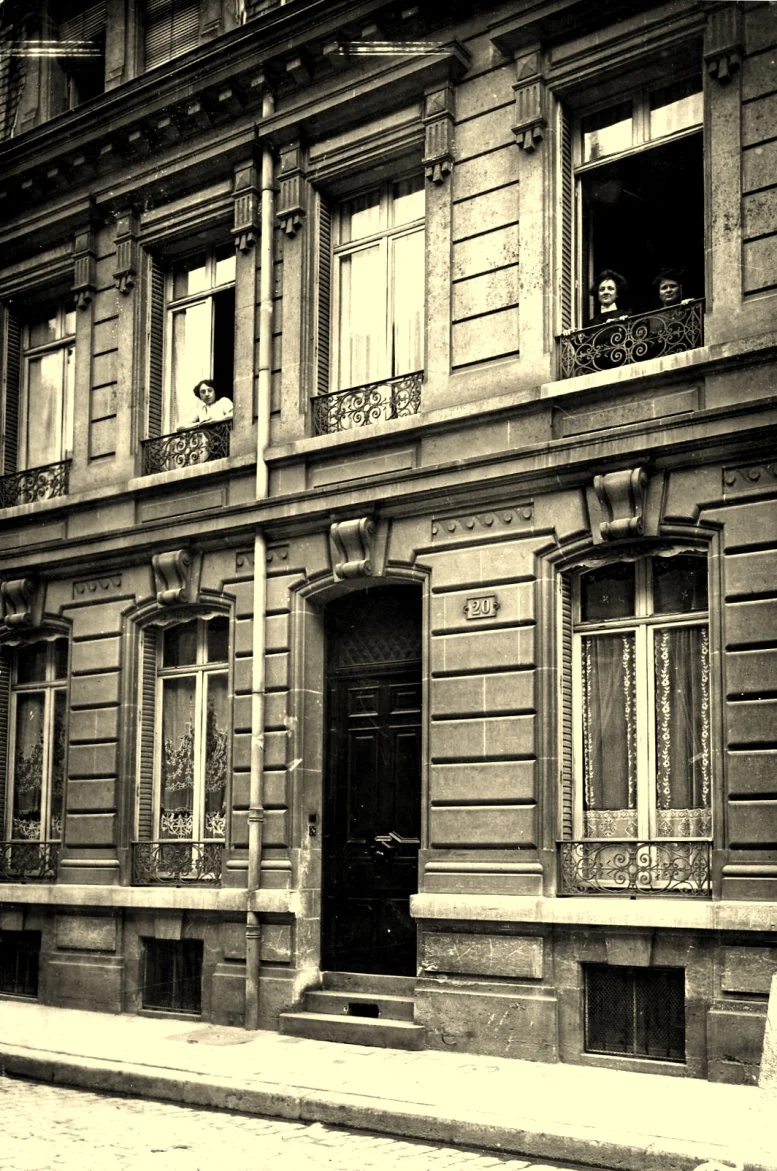
Stories by Marguerite Maillet (1873-1959) living in Reims, 20 Werlé Street - War of 14-18
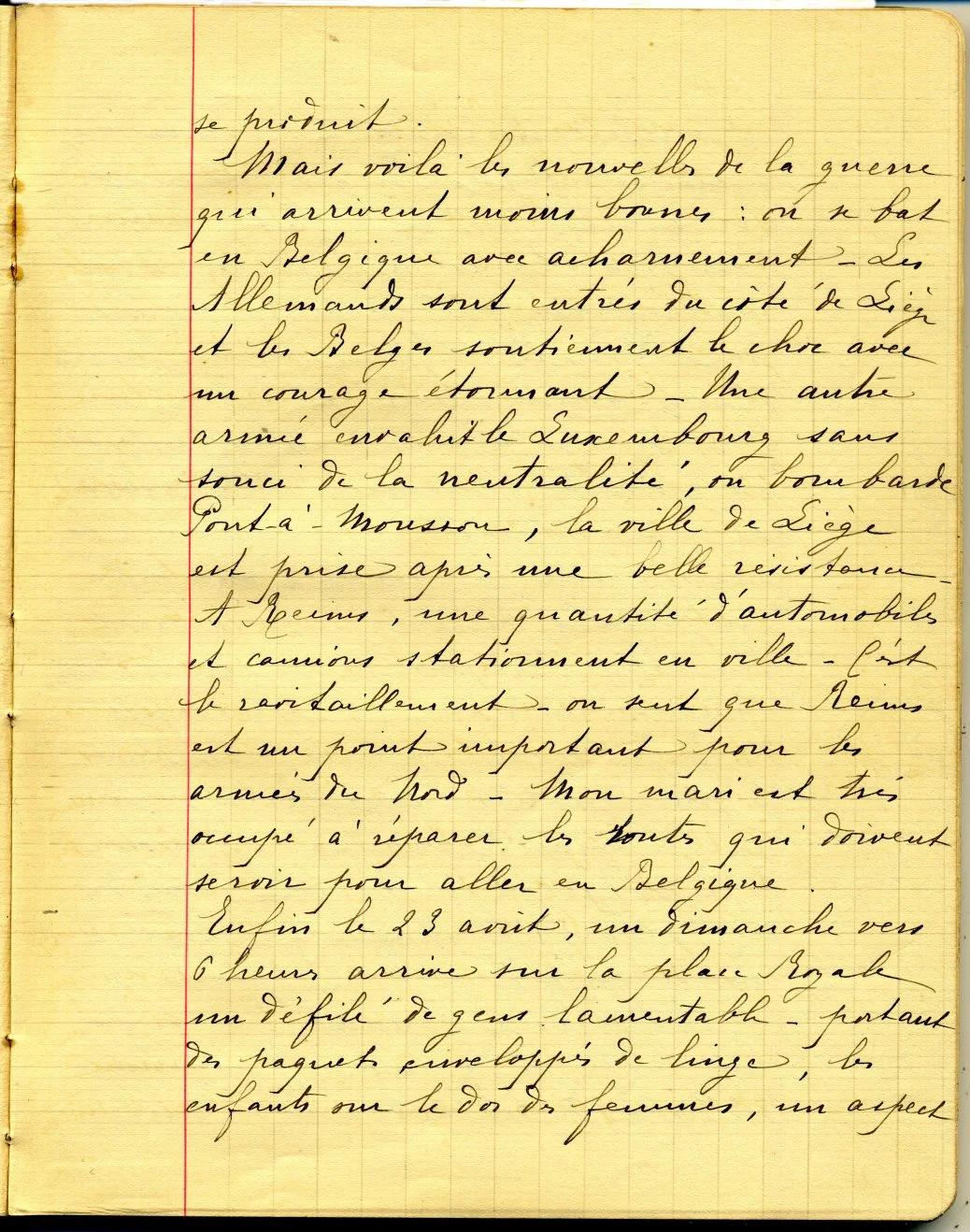
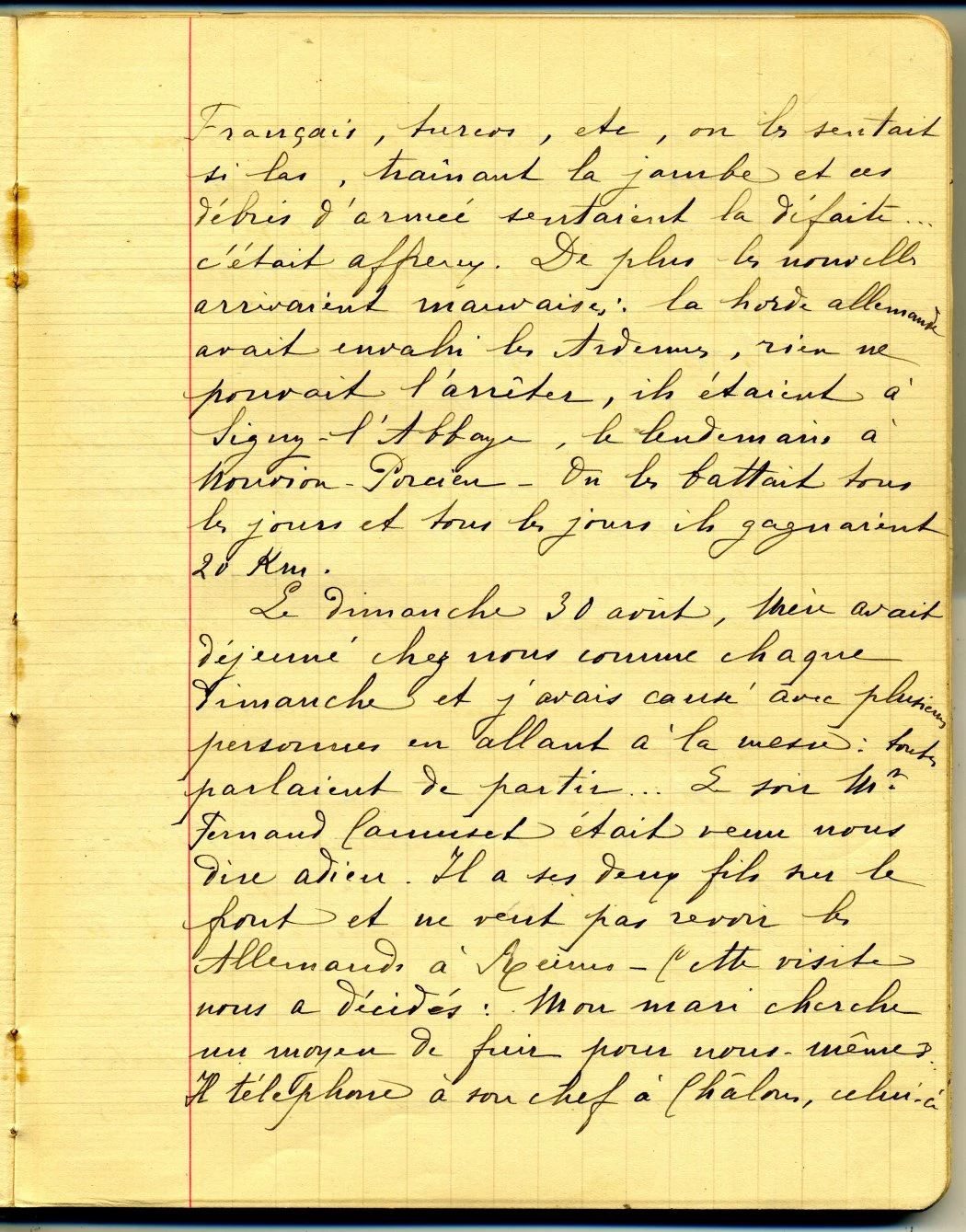
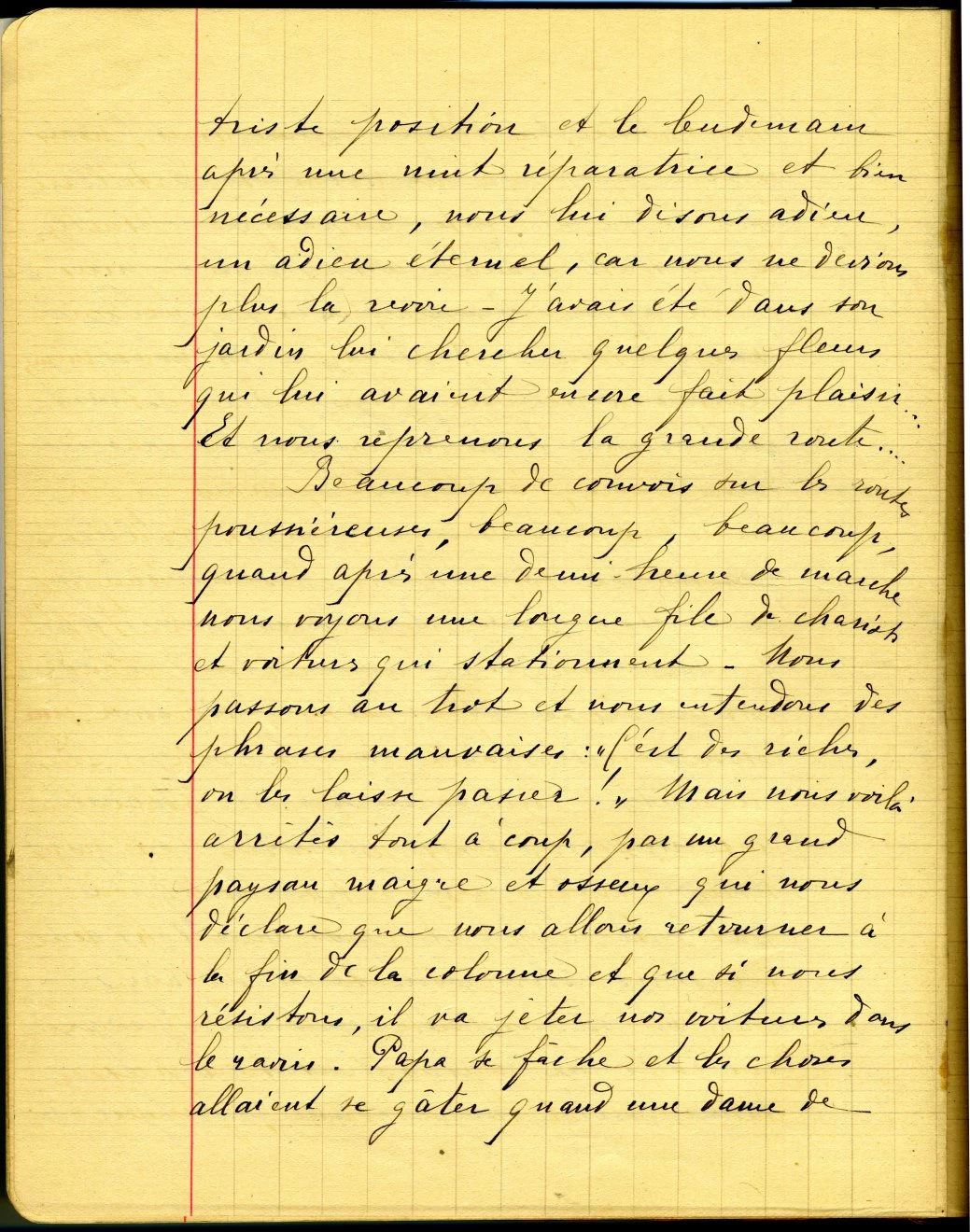
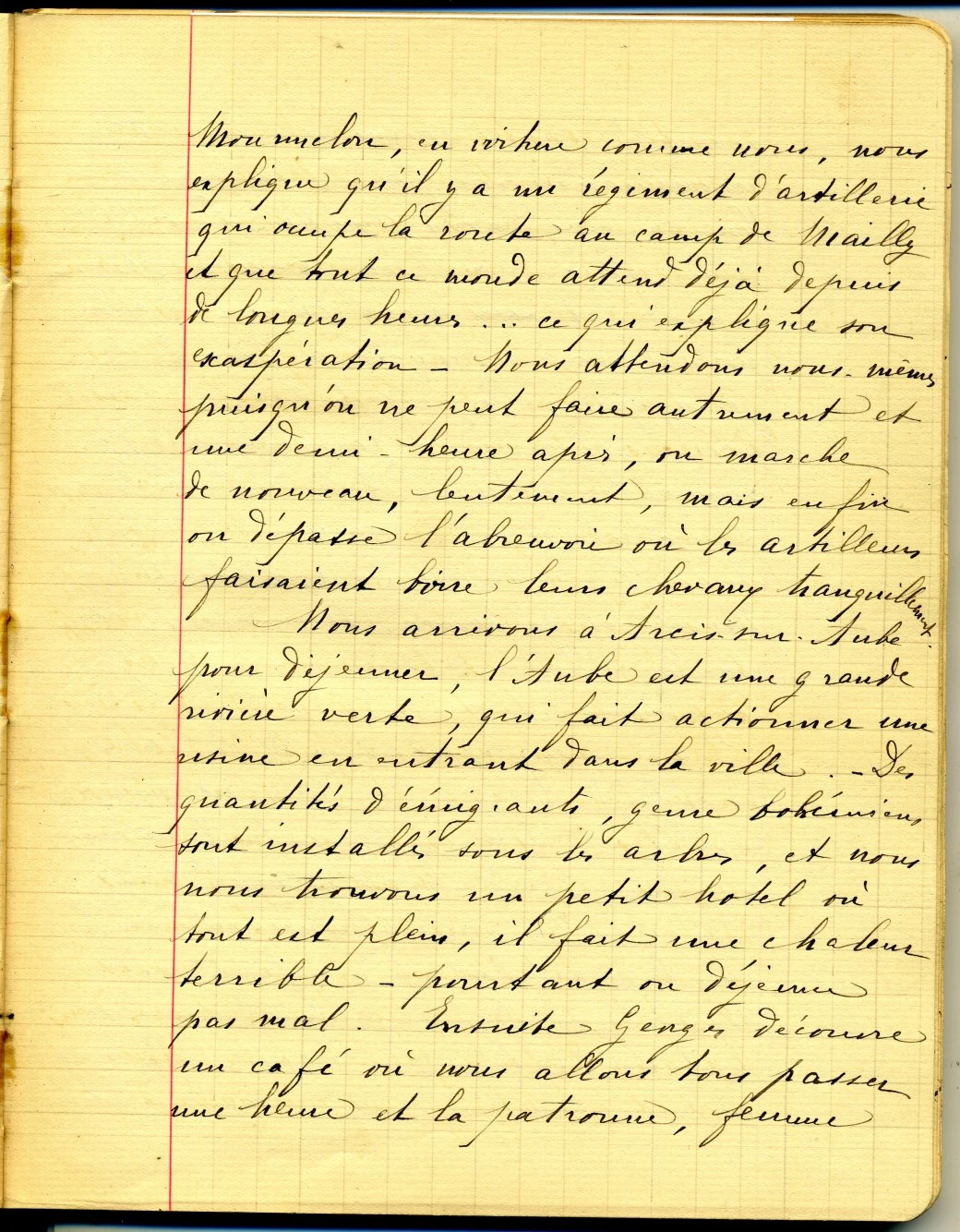
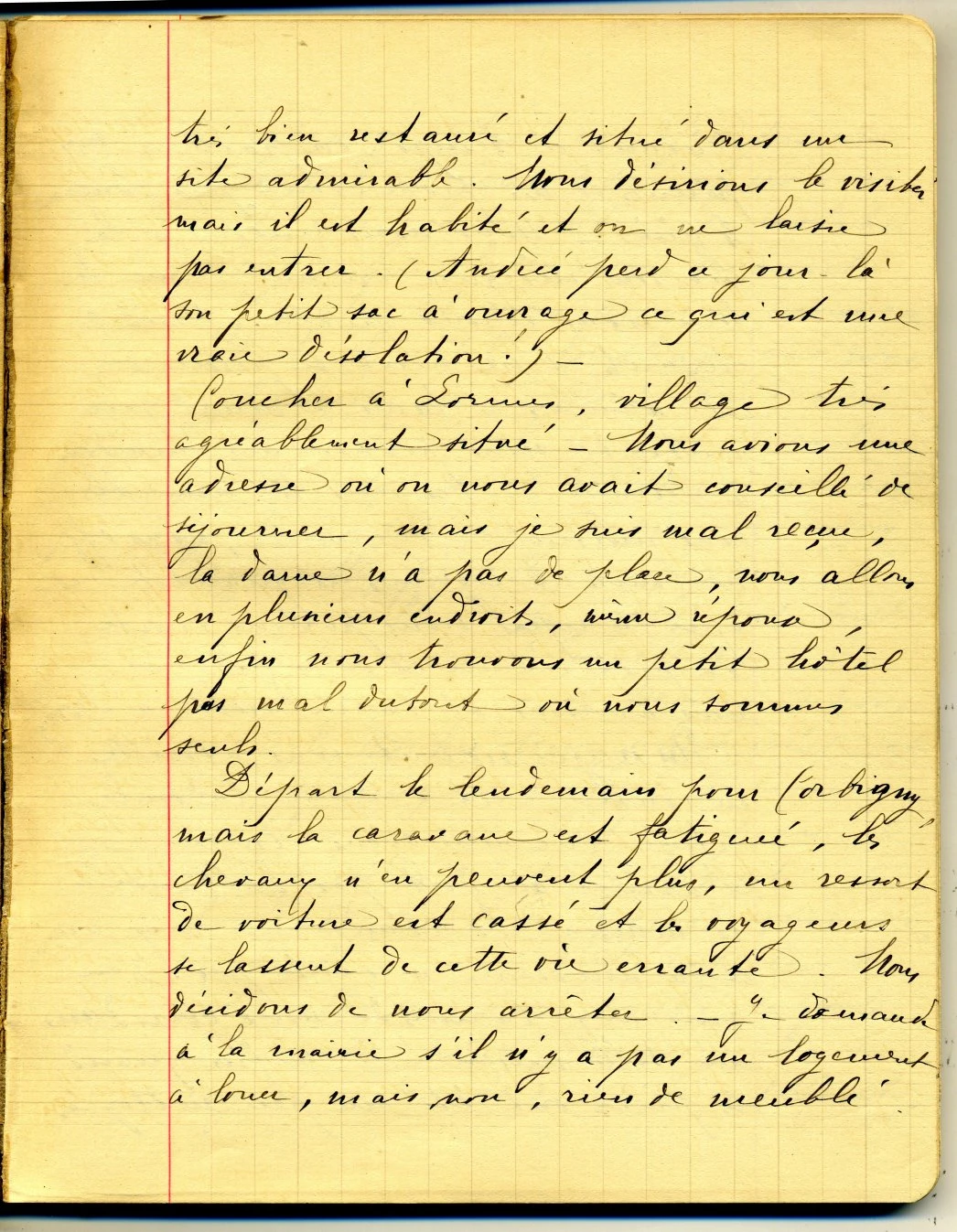
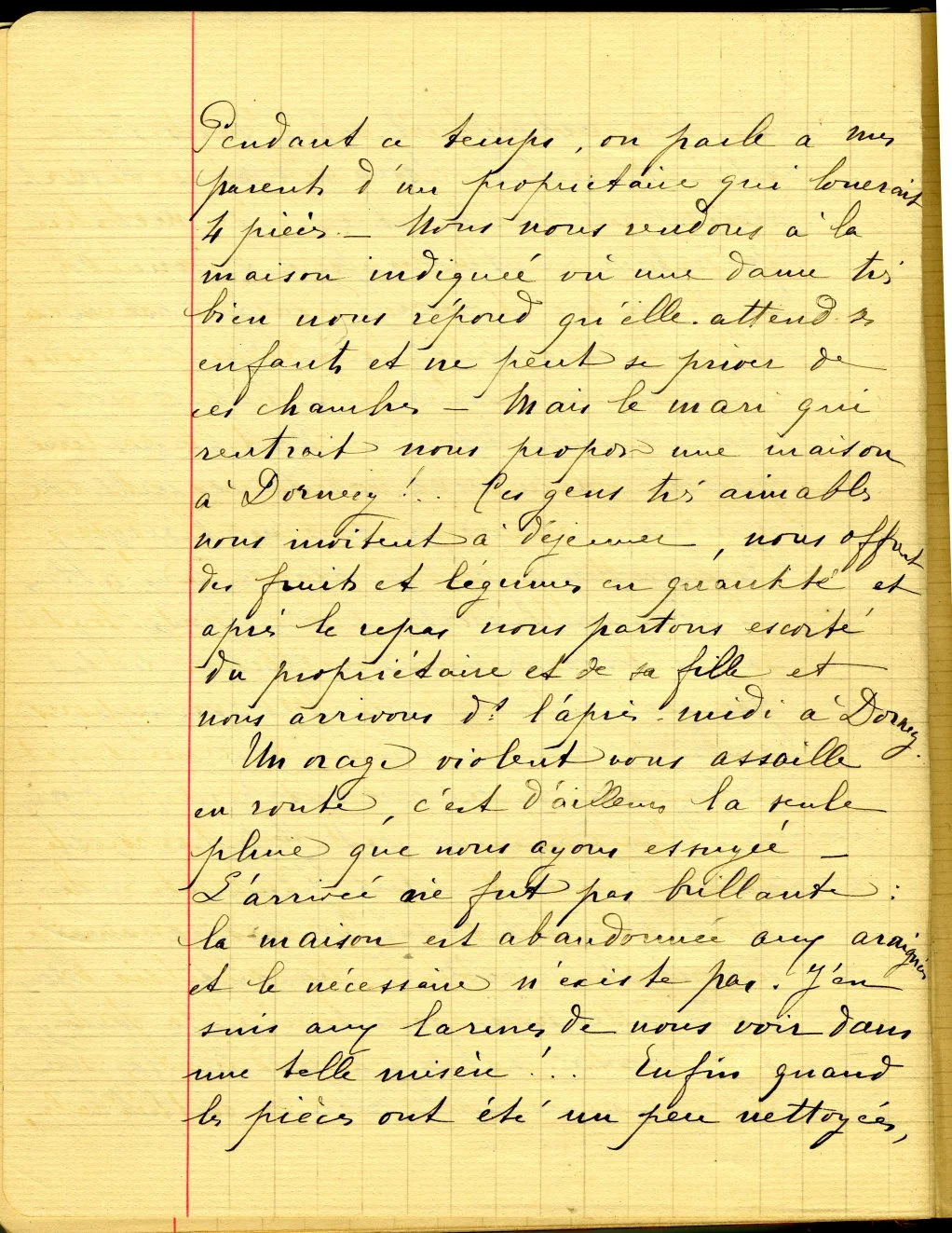
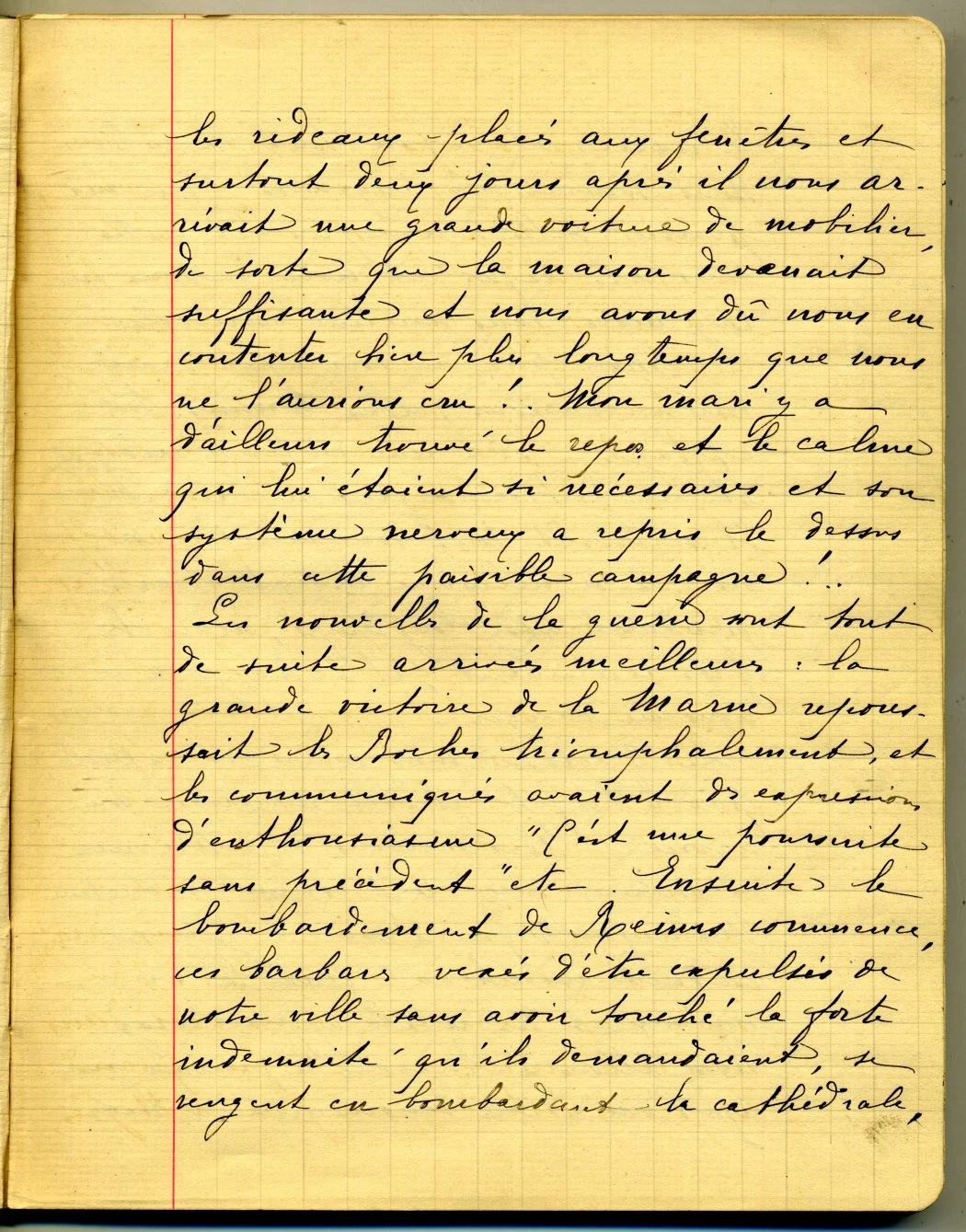
7 pages of these schoolbooks have been scanned and are reproduced here:
Page 5, 6,
7,
16,
17,
25,
26,
27
"1914
I was in Amsterdam with the children (the 3 boys René 17 years old - Etienne 15 years old - Marcel 13 years old, Suzanne 14 years old (future Granie, Claude's mother and Gaëlle's grandmother) was in Asnelles with her cousin Yvonne Thirion often called Vonnette, Andrée 9 years old had stayed in Reims) when a dispatch from my husband (Georges Maillet 1865-1928, engineer of the Bridges and Chaussées) came to warn us that the war was threatening (Tuesday 28 July).
We had no newspaper since we left France 5 days before, and we had the complete astonishment. That evening we saw in the leaves sold in Holland that Austria had sent Serbia an ultimatum impossible to accept.
The next Wednesday (29 July), another dispatch from my husband reminded us imperatively and Étienne that I had to leave Aachen for 6 weeks had to return with us by Belgium.
So on Thursday morning (30 July) we took the express from Paris and after driving all day in this quiet and prosperous country we were in Reims at 7 a.m.
We find my husband and my little Andree in good health and all happy to be together...
We already feel a certain concern in Reims, without believing in the war, we fear it and from the next Friday (31 July) we make provisions of all kinds, the grocery stores are devaluated and remain closed part of the day: the salt in particular reaches the price of 0.50 per kilog. (it was worth 10 cents! - late note from her daughter Suzanne, also called Granie)
On the night of Friday to Saturday (1 August) we are awakened by military music and around midnight the 132nd part for the border. Great emotion in the middle of the night: we see the soldiers marching on the boulevard, we feel an anguish that embraces you.
On Saturday, August 1st, trains are reserved exclusively for the transport of troops and without warning to the public, trains which are not allowed in.
On Sunday 2 August, the general order of mobilization was displayed in all the communes of France. This departure of the troops was in perfect order, the trains followed each other by 10 minutes in 10 minutes and everyone went with enthusiasm, singing. The wagons were decorated with flowers and ironic jokes at the address of Guillaume! (Guillaume II, the Emperor of Germany) A sublime moment where the French nation had proved to be vibrant and inflamed! It was no longer a question of parties and divergence of opinion, the entire elite of youth left to defend the homeland. A memorable sitting of the House devotes this magnificent movement.
(August 3rd declaration of war by Germany against Belgium and France, and beginning of the German offensive)
All week the mobilization continues in a perfect order; in the city we continue our supplies and I fill my cabinets as to support a seat. We work on all sides for hospitals, shirts, sheets and linens of all kinds are prepared for the wounded.
All this first part of the war is in the most complete hope, we see the constant movement of soldiers and convoys. All are happy with the clothes and food. As for the ladies of the city, they all work to prepare hospitals, I promise my assistance to Dr. Mencière and I immediately begin a quest with a young officer's daughter. We receive various offerings according to the means and generosity of each one, but we gather however a sum of 1050 F which is superb after all the quests that have already been made.
On August 15 the first wounded arrived at the hospital. They came from Mangienne near Verdun where a rather hot encounter took place. Nothing serious as an injury, after 2 or 3 days best happens.
But here are the news of the war that comes less good: we fight in Belgium with a great deal of effort. The Germans have entered the side of Liège, and the Belgians support the shock with amazing courage. Another army invades Luxembourg without concern for neutrality, we bomb Pont-à-Mousson, the city of Liège is taken after a nice resistance. In Reims a quantity of cars and trucks station in the city - it is the supply - we feel that Reims is an important point for the armies of the North. My husband is very busy repairing the roads that must serve to go to Belgium.
Finally on August 23, a Sunday at about 6 o'clock, a wretched parade of people arrived in Place Royale - carrying packages of linen, the children on women's back, an incredible aspect of misery. It was the first Belgian refugees who came to us after Charleroi's defeat. How many of those unfortunate people who were fleeing their devastated country had to follow their example!
This view had saddened me, and it felt the invasion and disaster so little expected!. I went home without talking to my husband who had been sleeping very badly for a few days: the news of the evening was especially impressive. The sad Belgian parade was to continue the following days, because the Ardennes were also coming. So horrible things were told about these German barbarians that everyone was fleeing as they approached.
This last week of August was very sad in Reims. There were troops of all kinds, Belgian, French, Turkish, etc., they were felt if weary, dragging their leg, and these pieces of army felt defeat, it was terrible. Moreover the news came bad: the German horde had invaded the Ardennes, nothing could stop them, they were at Signy-l'Abbaye, the next day in Nouvion-Porcien. They were beaten every day and every day they won 20 km.
On Sunday 30 August, Mother (mother of Marguerite Maillet, or Fanny Maillet-Valser1839-1919, widow of painter/gravor Augustin Maillet, resident Reims at 23 rue Boulard) had lunched with us every Sunday and I had caused several people to go to Mass: all were talking about leaving... In the evening Mr Fernand Camusit (a friend, who was remarried by a daughter of the Maillet-Valser) had come to say goodbye. He has his two sons on the front and does not want to see the Germans in Reims. This visit decided: my husband is looking for a way to escape for ourselves. He calls his boss in Châlons, he knows nothing and says that we are being spooked, but my husband insists and declares that he is leaving whatever happens. He immediately asks the director of CBR to facilitate his departure from Reims and it is agreed that a special train will wait for us tomorrow at Jacquard station. I make my preparations, we accumulate in suitcases as many things as possible, René and Andrée (2 of the 5 children of Marguerite) are alone with us, René will go from Châlons to pick up Etienne and Marcel (2 other children of Marguerite, the 5th Suzanne is in Asnelles in Normandy with the Thirion) to Dampierre (the house of Marguerite's parents: Emile and Sidonia Charpentier) , and we take my cook Catherine who is a capable girl. Everything is well agreed so, René will look for passports at the town hall, because since the war we no longer circulate without a pass.

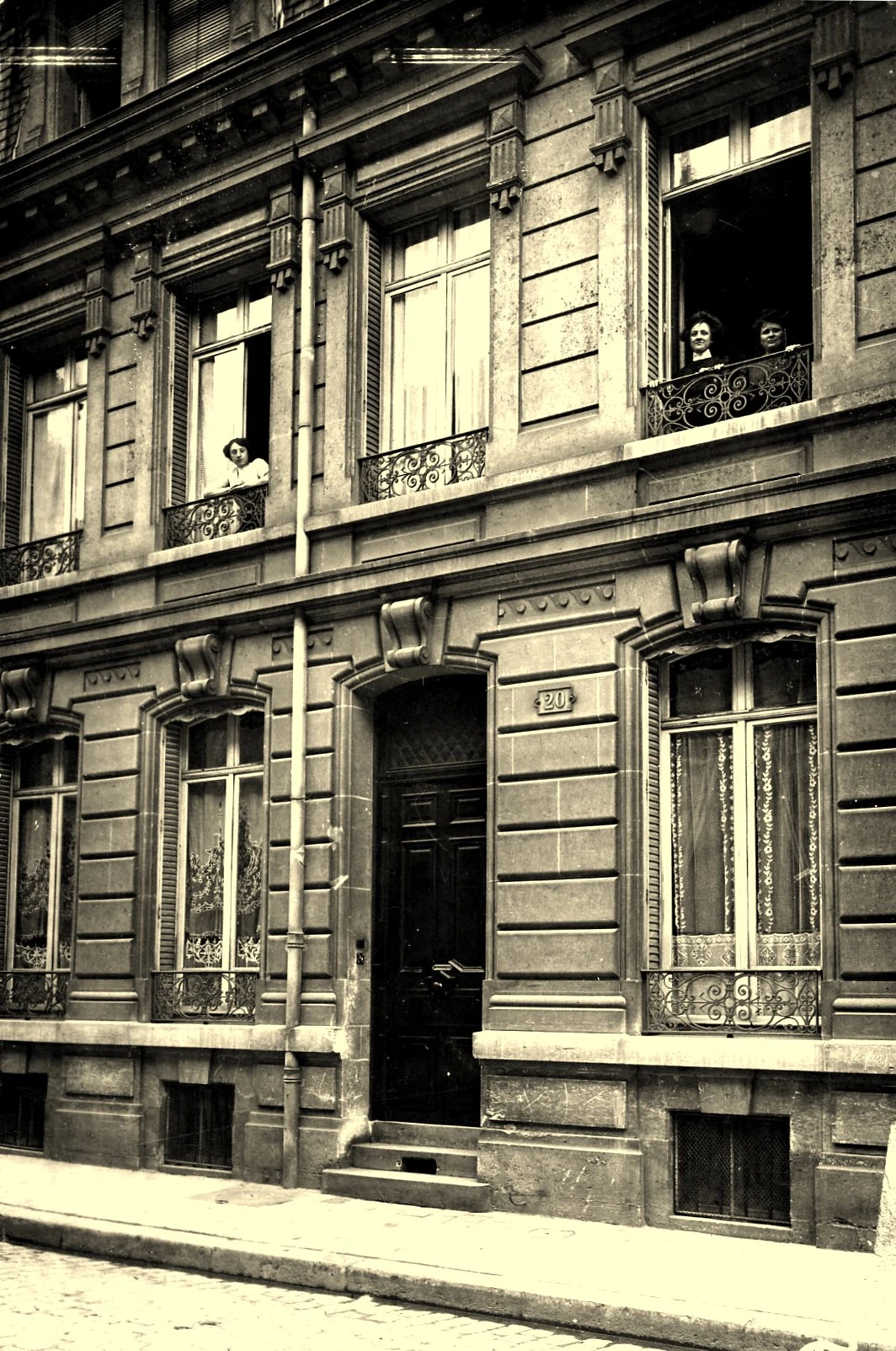

(details) 23 rue Boulard, Maison des Maillet-Valser in 1914, rebuilt in the year 2000, owned by the University of Reims,
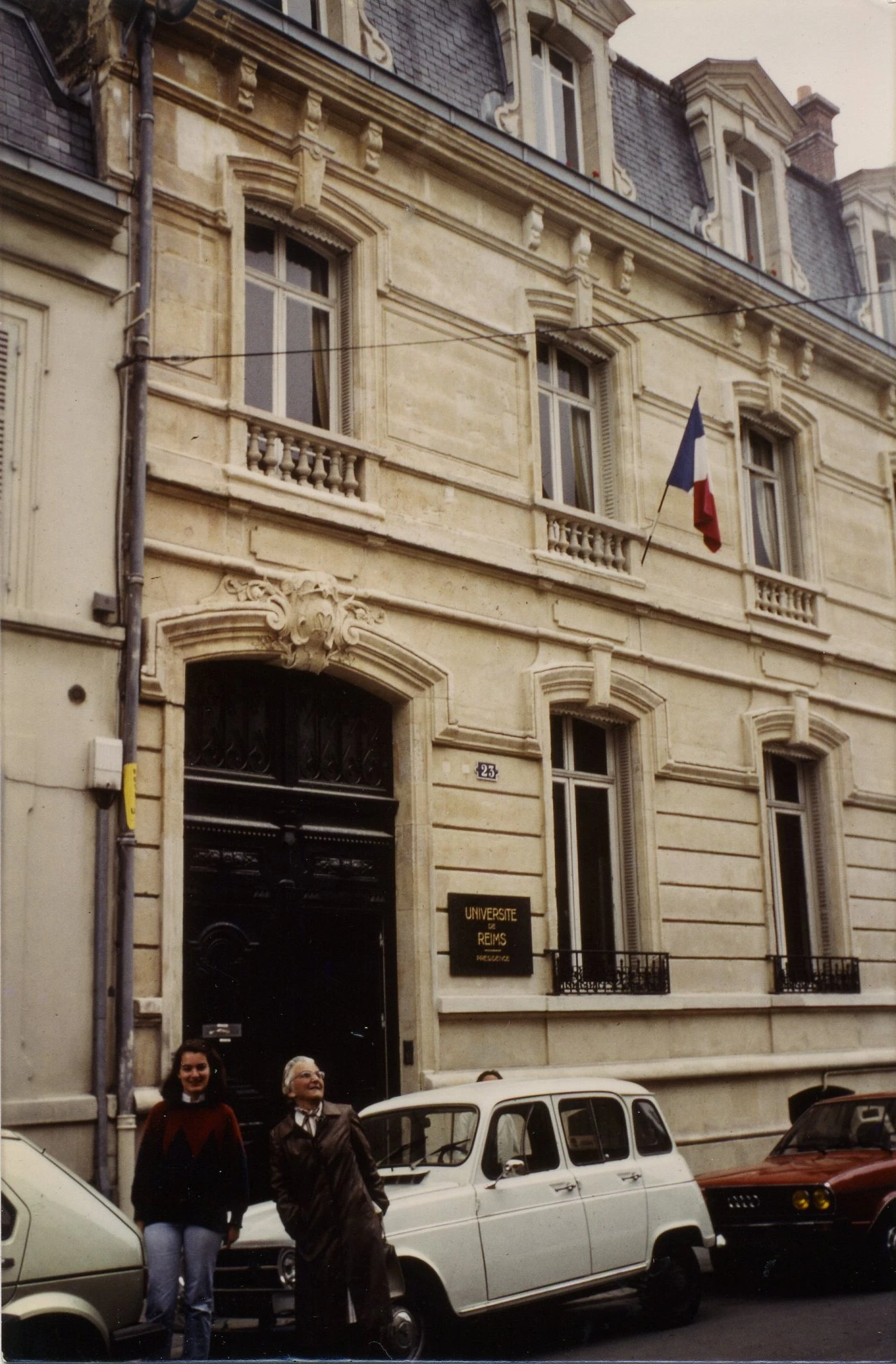
taken around 1980/83, with Angélique(? to be checked) and Tandree

The house on Boulard Street in 1919, after the German bombings, the house had received 3 shells.
The next day (31 August), when my husband was on the job, I was delighted not to leave my house, and they decided to go to Rue Boulard (at Marguerite's parents-in-law, the Maillet-Valser, who, aged, will not leave) and to make René leave by bicycle, alone or with a friend. But at 4 hours great amazement, Dad (Emile Charpentier) arrives from Dampierre with Marcel, very quiet all in spite of a long trip (they used the train ??) - they bring us fruits, provisions, etc! I'm telling them right now that Reims is going to be invested in two or three days and we're looking for a way to get Marcel out of his way.
After thinking about it, Dad proposed to go with his car (it is probably a horse car, the motor vehicles, rare, were called automobiles), the three boys on bicycles, but he had to go back to Dampierre to put different things in safety, he will bring Mom (Sidonie Charpentier) and Etienne, and we will make an appointment for Wednesday 2 September at 2 o'clock at Mr Sigault (most likely the chief engineer of the Bridges, in Châlons, boss of Georges Maillet). Dad (Emile Charpentier) returns to Dampierre, the Reims station is unaffordable, and he is apprehended for asking a soldier where he was going. We see spies everywhere! He lies on a bench at St-Hilaire station and arrives in Dampierre broken with fatigue in the morning.
Meanwhile, Georges (Maillet) has our trip again. He calls Mr Sigault again, then at the CBR where a train is still available. Next day (1st Sept., departure from Reims) All set, what a start! We abandon our home, everything that has made our lives for 20 years! Mother who does not want to leave her house remains alone. Mrs Picard our neighbour and Mr Subtil to whom we let the keys come say goodbye and we go crying, Georges like me, so much this departure to the unknown is tearing.
The journey is going well, very comfortable wagon, my husband is embarrassed to see himself in the living room of the great days when he abandons his service.... We arrive at Châlons at noon, in a great heat. René is looking for us a car at the station and immediately we feel a relief by finding the city so quiet after the hell that Reims has been in for 8 days. Mr and Mrs Sigault welcome us with great kindness, and in the afternoon we rest Georges and me. René goes to Sarry and the two little ones play without taking care of the drama that unfolds around them... In the evening we learn that the Prefecture (the one of the Marne, in Chalons) is leaving and that the Posts are directed towards Clermont-Ferrand, it is the flight.... Then all those who had called us "froussard", Henri (Maillet, Georges' brother, farmer in Sarry), Létandart (a cousin further away, side Maillet), and even Mrs Sigault change their attitude and everyone is willing to imitate us.
Mrs. Sigault will take a train to Troyes at 4 a.m. and that same day (2 Sept.) in the morning, the officials of Reims all arrive by various means. We have lunch with the ladies Bourguin and a young polytechnician, fast and rather quiet lunch, and immediately after we see Dad (Emile Charpentier, from Dampierre) and Etienne, who came again quietly and did not believe in danger! Mom (Sidonie Charpentier) did not want to accompany them! We are in fury, and Georges says that we will keep the car to go to Sarry... Etienne drives and it's not fast, the brave Mouton (the horse, who is tired) already arriving from Dampierre....
Dad (Emile Charpentier) returns as he can (in Dampierre) with the help of Mr Blanchard de Courtisols, and returns on foot for the end of his journey at 9 o'clock in the evening.!... He finds Mom (Sidonia) completely changed his mind, and ready to go by cart with Léon Michel (a cousin of Sidonia Charpentier), farmer and neighbour in Dampierre.
The brave Leon Michel, like Providence, lends them a horse with a second car, they come to meet us in Sarry at 4 o'clock in the morning, both iced from the cold of the night!...
We had spent the evening of September 2 with my sister-in-law Jeanne (Maillet, wife of Henri Maillet) very worried about what she was to do: her husband being taken by military service (Henri Maillet is mobilized). She has to travel by car with her friends Simon and these only want to leave at the last minute. On the morning of the 3th however, they decide, and we leave Sarry at almost the same time. (departure from Sarry on 3 September)
(for memory, on September 4 the Germans occupied Reims a few days, until the German debanda of the end of the Battle of the Marne, around mid-September)
For us the journey becomes easier with the 2 cars, René will go alone in a bicycle scout, and all the luggage can be set. Beautiful morning, superb weather, but the cannonade rages in the direction of Suippes and it is to the sound of the cannon that we take the sad road of exile!.
What a day!. The coast of Sogny (at the southern exit of Sarry) rises very steep, and we start by climbing it on foot. At Ecury sur Coole (about 7 km southwest of Sarry), a horse is unloaded, all this is not going forward, and we have such a desire to flee... At noon we are in Bussy-Lettré (20 km to the SO of Sarry) where I am told to the hotel (?) that there is nothing left to eat, fortunately Mom has provisions, we are supplied with drink and coffee and we give way to others - there are many soldiers more or less well arranged... We step back, we always step back, and discouragement wins this demoralized army.

Click on image to enlarge
1914 -1920
Dates of Georges and Marguerite Maillet's stays and trips
_______
- Departure from Reims on September 1, 1914, by train, destination Châlons-sur-Marne (now shawls-en--Champagne, as before the Revolution)
- Road from Chalons to Sarry, the evening of September 2
- Sarry to Sêtes on September 3
- Route from Sommes to Voué on September 4
- Route from Voue to Estissac, by Saint-Lyé on September 5
- Estissac road to Ervy on September 6
- Road from Ervy to Noyers on September 7
- Road from Noyers to Avallon on September 8th
- Route from Avallon to Lors by Chastellux on September 9
- Road from Lormes to Dornecy by Corbigny on September 10
- Stay in Dornecy from September 10 to October 3
- Departure of Georges, Marguerite and René, from Dornecy to Auxerre on October 3, and from Auxerre to Ervy on October 4
- Stay of Georges and Marguerite in Ervy from 4 October to about 25 October
- Back to Dornecy at the end of October
- Stay in Dornecy from late October to early December
- Departure from Dornecy to Paris and then Epernay by train at the beginning of December: Georges, Marguerite and René, René remains at the Henri IV high school in Paris.
- Stayed in Epernay from December 1915 to September 1916.
- From Sept 1916 to 1920, stay in St-Cyr-sur-Loire, before installation at Sceaux until 1959
We take a nap to avoid the heat, and we drive back to Resous (35 km away from Sarry's SO). The dust of the roads, all kinds of convoys, cars, carts, herds are on the road. We arrive at Resous at about 4 o'clock (September 3), we find the good aunt (this is Augustine Maillet's sister, Aunt Mélina Maillet, widow Letandart, 79 years old) on her bed, she had her leg broken two months ago, and a phlebite immobilized her. She made us prepare beds in the village, and thanks to it we find ourselves staying. The country is crowded with soldiers and emigrants and even a corner of a barn is refused to those who arrive late. Mom, who is broken with fatigue with sleepless night and the emotions of the day rested upon arrival.
We just announced to the village that the inhabitants will have to evacuate at the first signal, and we do not know if the night will happen without this departure. Fortunately it was nothing, George gets from a cousin that he takes the aunt on a cart with a mattress, and so the poor woman escaped the terrible death that was waiting for her. (For shortly after - September 6 I believe - the Germans entered the Resous, the fighting lasted several days and the city burned, the Germans abandoned the fight around September 11, at the end of the battle of the Marne, retreating, beaten, north of Reims)
We have seen all the relatives and friends that Georges had known (this village is that of Georges Maillet's grandparents), we have dinner with the good aunt, always cheerful despite her sad position and the next day after a restorative and necessary night, we say goodbye, an eternal farewell, because we were not to see her again. I had been in her garden to get some flowers that had still made her happy... and we resume the great road...(departure from Sezous on 4 September).
Many convoys on the dusty roads, many, many, when after half an hour of walking we see a long line of carts and cars parking. We go to the trot and we hear bad sentences: "It's rich people, we let them pass!" But we suddenly stopped, by a great lean and boned peasant who tells us that we will return to the end of the column and that if we resist, he will throw our cars in the ravine. Dad was angry and things were going to get messed up when a lady from Mourmelon, a car like us, explained that there was an artillery regiment that occupied the road at Camp Mailly (10 km south of Resous) and that everyone had been waiting for long hours... which explains her exasperation. We wait for ourselves since we cannot do otherwise and half an hour after we walk again, slowly, but finally we go beyond the water where the gunners were drinking their horses quietly.
We arrive at Arcis-sur-Aube (25 km south of Resous) for lunch, the Aube is a large green river that makes a factory operate when entering the city. Quantities of emigrants, like bohemians, are installed under the trees, and we find a small hotel where everything is full, it is a terrible heat - yet we have a pretty good lunch. Then Georges discovers a coffee where we will spend an hour and the boss, friendly woman, gives us a word of recommendation for the innkeeper of Voue (9 km south of Arcy-sur-Aube) where we have to sleep tonight. This good lady didn't think to leave yet, and having changed her mind, we found her in Ervy 2 days later, she had arrived there before us.... the panic was spreading in the Aube department and the inhabitants were also beginning to evacuate!... The battle fortunately stopped in Mailly and poor Resous, like many neighbouring villages, was almost completely burned.
The recommendation of the lady of the café of Arcis was very necessary, this village of Voué does not present any resources. The innkeeper gives us 2 bedrooms; ( on the 4th evening ) one is found opposite to the marshal and the children are housed at a young woman who puts a mattress on the floor. The night goes without incident, we who were housed at the marshal ferrant, we are awakened by the avil at the tip of the day... finally the journey resumes its course at 7 am (departure from Voué on 5 September)The troops and the emigrants are still in the middle of the road, so we decide to take the vicinal paths. This morning we follow an absolutely lonely path, and, much different from the previous days, we do not meet anyone at all. The car cycle is as smooth, so we know the calm and everyone is satisfied. The landscape becomes more beautiful, we cross the Seine and the canal and we arrive at Saint-Lyé (at 25 km at the SO of Arcy on Aube, but at 12km at the NO of Troyes which is thus bypassed by the west) for lunch. We visit the church with Georges and we go back in the afternoon. It is very hot, René has a flat tire, we are obliged to wait for him at the corner of a wood. Then comes a long coast that must be climbed on foot... finally we arrive in a village of good appearance, but where we do not find ourselves staying, we have to go until next, Estissac (20 km to the SO of St-Lyè and 25km west of Troyes), a few kilometers, and there a good hotel receives us without difficulties. (on September 5th evening)
Everyone causes war, on the terrace taking lemonades, and everyone says his impression. At dinner, a veterinarian from Pagny (near Châlons) tells us some grim things about the 17th Corps he has just hosted - despair is getting into the public, we wonder with this retreat where the French army is?...
We lie down on these sad ideas and at midnight we are awakened by a noise that seems to us to be the cannon. I go to the window and see that the night is wonderful and quiet, but about ten horses of the gendarmes are tied under our window and the sound of their hoofs that are piling us up gave us this illusion!...
The next Sunday (departure from Estissac on 6 SeptemberWe are crossing the forest of Othe, the country is lovely, we walk for a while and we admire the beautiful trees. It has been a long time since we had anything beautiful on the horizon!... We arrive at 10 o'clock in a very small village where Mass was just ringing. We attend and see that our band alone is half the audience - in all a dozen people - there is no choir child - and yet the priest gives us an admirable sermon, on war of course, but worthy of a cathedral by the ideas and the way to express them. How sad it is for a zealous and intelligent priest to be reduced to such a parish!...
We have lunch again thanks to the provisions of Bonne-Maman and in the evening we arrive in Ervy (on the 6th seven at night, Ervy-le-Chatel, 40 km south of Estissac). My parents meet several people from Dampierre, who left after them, and give them news of the arrival of the Germans. Everyone is terrified, and we always flee. We see the lady of Arcis-sur-Aube who gave us an address. Good little hotel, we are numerous at the table and the rooms are acceptable. (starts on 7th Sept.)
by Tonnerre (30km south of Ervy) . It's hot, we arrive in this very crowded city, a hotel overflowing with emigrants, we wait for a mediocre dinner served by a very well-preserved middle-aged town.... When we leave the city, we have to climb a huge hill, everyone is breathless! We will sleep in Noyers (60 km south of Ervy), a small town with a very well-preserved medieval area. A round road, a square with old houses, and a very curious town hall. We are well housed and find an owner of the Ardennes and his family who are particularly affected by the war. We only hear lamentable stories, we are in the happiest, because many have had to flee without taking away anything!
(departs from Noyers on 8 Sept.)From Noyers to Avallon the landscape is very rough, we follow the valley of the Serein, a picturesque little river and the country of the Avallonis itself is renowned. We eat in Savigny-le-Bois, well named, lost in the greenery. We offer accommodation, but our desire for escape is not yet satisfied, we go ever further! ... In Avallon (30km south of Noyers), coming down a long coastline, we are surprised to find Pierre Maillet (son of Henri and Jeanne Maillet, of Sarry, 18 years old) and Mr and Mrs Simon. We are delighted to meet you and stop the trip for today and spend the evening with them. My sister-in-law is always worried about her husband and her farm. We reassure her as best we can, but no one is very reassured at this moment, she is circulating stories of invasion and we can believe that the Boches have destroyed everything in their passage!... This town of Avallon is very steep, there are staggered gardens against the coast and a high terrace from which we have a superb view.
We're continuing (departure from Avallon on 9 Sept.) by Chastellux, a small country where we had to sleep without the meeting of the day before, but where we would never have found ourselves to stay! Another angelic chance as many occur during the journey! There is in Chastellux a superb castle very well restored and situated in an admirable site. We wanted to visit it but it is inhabited and we do not let in. (Andrée (9 years 1/2) loses that day his little bag, which is a real desolation)
Sleeping in Lormes (30 km south of Avallon), a very nice village. We had an address where we were advised to stay, but I am not well received, the lady has no place, we go to several places, same answer, finally we find a small hotel not bad at all where we are alone.
Departure the next day (departure from Lormes on September 10) For Corbigny (15 km at the SO de Lormes), but the caravan is tired, horses can't do it anymore, a car spring is broken and the travelers get tired of this wandering life. We decide to stop. I ask the town hall if there is not a dwelling to rent, but nothing furnished. Meanwhile, we talk to my parents about a owner who would rent 4 rooms. We go to the indicated house where a lady answers that she waits for her children and cannot take away from her rooms. But the husband who was returning offers us a house in Dornecy! These very kind people invite us to lunch, offer us fruits and vegetables in quantity and after the meal we leave escorted the owner and his daughter and we arrive in the afternoon in Dornecy (20 km north of Lormes, on the Yonne and 7km from Clamey).
A violent storm is coming on our way, and it is the only rain we have been wiped off. The arrival was not brilliant: the house is abandoned to spiders and the necessary does not exist. I am in tears to see us in such misery!... Finally when the rooms were a little cleaned, the curtains placed on the windows and especially 2 days after we arrived a large car of furniture, so that the house became sufficient and we had to settle for it much longer than we would have thought! My husband found the rest and calm that was needed and his nervous system took over in this peaceful countryside!.
The news of the war came right up. The great victory of the Marne pushed back the Boches triumphantly, and the communiqués had expressions of enthusiasm "it is an unprecedented pursuit" etc. Then the bombardment of Reims begins, these barbarians being offended from our city without having touched the heavy compensation they were asking for, avenge themselves by bombing the cathedral, the factories, and finally the whole city, we are very worried for my poor mother-in-law (Fanny Maillet-Valser, widow) who stayed in this hell and we remain a long month without news.
My father, one evening after dinner, falls faint, we are very scared. He has a violent indigestion and some brain congestion. He recovers very slowly: his sight and memory remain altered for quite a long time, but his forces come back, he escapes a new danger.
On October 3 (about 4 weeks after arrival in Dornecy) my husband is reminded by the Prefect: he must resume his service. We decide to return by car with René as driver
(departure from Dornecy on 3 October).
My children who had never driven a horse are doing this a serious and very useful learning. à To be able to go on the first day (Saturday, October 3) after a moving farewell to my poor parents that we left alone and to my 3 children Etienne, Marcel and Andrée. Fortunately cook Catherine is a dedicated and capable girl and she is very precious to them.
First tiring day, many ribs. In the evening in Auxerre, I have a terrible migraine. The next morning I attend Mass (the cathedral of Auxerre is very beautiful) and we Let's go (from Auxerre on Sunday 4 October)We're having lunch at the station in St-Florentin, where everyone is causing war. We're trying to get information about Reims where we were supposed to go. We can't tell us anything. We're talking about the fires in Resous, Sermaize and Revigny, we feel much more in the war than in Dornecy. We immediately feel an atmosphere of anxiety.... In the evening (of October 4) we arrive in Ervy We're back with a nice hotel mistress, and happy to have some guests. During the night my husband is rebuked with nervous anxiety as he had at the end of August. He's very uncomfortable, suffers from all kinds of pain, so we decide not to continue our journey, René will go on a railway to Châlons to warn the Engineer in Chief and we stay in Ervy waiting for him.
Her journey goes as well as possible, Mrs Sigault decides that we cannot return to Reims and advises to wait for orders to Ervy. René goes on a bicycle to Dampierre, he sees some damage, but little, and in Sarry he finds my sister-in-law and Pierre (son of Jeanne and Henri Maillet) returned only a few days ago and overflowed with military.
Our stay in Ervy lasted three weeks, we were still waiting, we were told that Reims was going to be delivered, but it was only a decoy, unfortunately, at the end of October, my husband had a rightful leave. (around 25 October) we are returning to Dornecy by Chablis, Arcis-sur-Aube and Vézelay.
This trip was quite nice. The autumn had golden wood, we were crossing beautiful landscapes, the valley of the Cure in particular (the road passes through tunnel) and the church of Vézelay is a marvel (remarkable Romanesque style) and from the terrace that surrounds it we have an immense view.
We go back to Dornecy where everyone is happy to see each other, my father is better, we take back the modest but quiet life that has done my husband great good. The last month was especially very profitable. I organize the studies of the children as best I can, I make them work every morning and at night by lamp, we read about the history of France. Etienne takes rehearsals of mathematics in Clamecy, and René works a little alone or with her father. In the evening we play manilla, and time passes! We arrive in December without "reims unlocking!", and then the second month of leave expires we're back in Epernay (early December?) where my husband is back in his service. by the railwayThe trains are all omnibuses, yet in La Roche, we are told an express that has been working for 2 days.
In Paris we take care of René who will enter the high school Henri IV and continue his studies (René will leave his prepa - a mole - in 1915 and voluntarily engage in the war, he will wage all the war in artillery then in the observation aviation, will become sub-lieutenant, after the war he will finish his prepa, will enter Polytechnique in 1920. He died in 1931 of tropical diseases contracted during his professional stays in Africa), and we arrive at Epernay after a journey of 6 hours, we pass on 3 bridges recently repaired, we see crosses in the field... We fought in this country. In Epernay an employee of the office was waiting for us, he takes us to the house he rented for us. We find there an old lady whose son was killed at the battle of the Marne, she puts her house at our disposal with infinite grace, and we sleep the same evening in all the prepared rooms. This poor lady leaves at midnight for Paris. We settle down thanks to the employees of the office who provide us with wood, coal almost unobtainable at that time. For food, everything is easy, there is even a pastry that is full of officers coming to taste the "pleasures" it is the name of the cakes and I think, the poor, that they also taste some! Nothing surprising after the days of fighting. Epernay became a mainly military city, he spends convoys a part of the night. Fortunately we are in a street withdrawn and we sleep quiet.
René stays with us until the beginning of January (in Paris, Henri IV high school). We go to Sarry for Christmas where we meet my mother-in-law who left Reims with his maid at the end of November. Joye to see herself, the Henris have found almost all their belongings, Mr. Salleron having remained during the German occupation (about 15 days in September) as mayor of the commune.
In Châlons, at Mr Sigault we see luxury again!A house like in the past with carpets, armchairs, etc., so long ago that we are unusualized that I have a real emotion.
The days pass, monotonous, but no one thinks of having fun or even distracting. We find the Hallades, emigrated (this term was used by the family for all the displaced from 1914, but in 1940/44, the term emigrés was no longer used, replaced by that of refugees) as we did, my husband saw some comrades officers, but we know nothing.... A great attack in Champagne failed (December 14), I learned the death of Felix Appert, killed as colonel at the foot of the Menil.. and how many others!
Big bombardments on Reims, one day we can go in car with Henri. I see our dear house (20 Werlé Street) and I cry leaving it again... We take away everything we can, I bring clothes that I send to the children to Clamecy.
Suzanne (14 years old, future Granie) returned from Cherbourg at the beginning of March (1915). Louis and Jeanne (the Thirion) brought her back.
Spring comes, we have a small garden that is very useful to us, my poor Georges walks more and more difficult, he needs two arms most often and we are looked at in the public squares where we sit... His office is installed in one well-rudimentary room, but the generals are contented with less....
Andrée returned with my cook from Reims (Catherine) in May, my parents left Dornecy and the two boys (Etienne and Marcel) stayed (in high school, boarding school) in Clamecy. The two little ones (Suzanne and Andrée) being with us life is less sad, they take lessons and Suzanne prepares his elementary certificate. Etienne fails her baccalaureate in July, which is not surprising with the disillusioned year that he had. René, on 31 May, committed himself to what emotion! He passed the revision in Chalons and goodbye the class and math. He is in Chartres where he makes a very hard deposit, we see him again one day in Paris, weightless and tired. The Thirion who are in Vaucresson receive it from time to time on Sunday.
"The 1914 War in Dampierre
"The Germans, having passed through Belgium, invaded France and arrived in front of Paris. The battle of JOFFRE has made them go back, they have suffered a disaster in the marshes of St-Gond and we have been able to continue them until a line remained almost stable for 4 years.
Henriette, the old maid, did not want to leave the house when her bosses went on emigration. The German occupation lasted 11 days. Henriette, very valiant (portrait to Dampierre over the wood stove) and devoted, during the night before the arrival of the Germans piled up some treasures and the wine in the second cellar and blocked it with stones and plaster. She wanted to save the hens she had locked up for 11 days and fed at night. She fed her brother-in-law, hidden in Fire-Gone (
..., like her sister suffering from heart and bed. There were so many German troops on the road that she took 2 hours to visit her sister at 500m. There were only a few inhabitants in Dampierre.
Henriette stayed 11 days without going to bed, sitting on a chair. The Germans said "grandmother, go to bed"..."we go to Paris," they said, "no, no," she replied, "you will not go to Paris." She was questioned by the Germans "is there any hidden soldiers?" (there were still 2 of them) The Germans put her in front of a wall and kept her. If we find the French, we will shoot you and Henriette added "I hid my savings in my skirt, if the Germans shoot me, my sister will not be able to take them back.
The Charpentiers went on emigration (in 1940 they said "exodus") to Dornecy, Nièvre, with the Maillet (except Suzanne (Granie) who was with the Thirion in Asnelles and then in Cherbourg), they remained there until the end of the classes of the brothers of Granie in boarding at Clamecy.... Then they returned to Dampierre (summer 1915), and lived with a French staff who were staying at home."
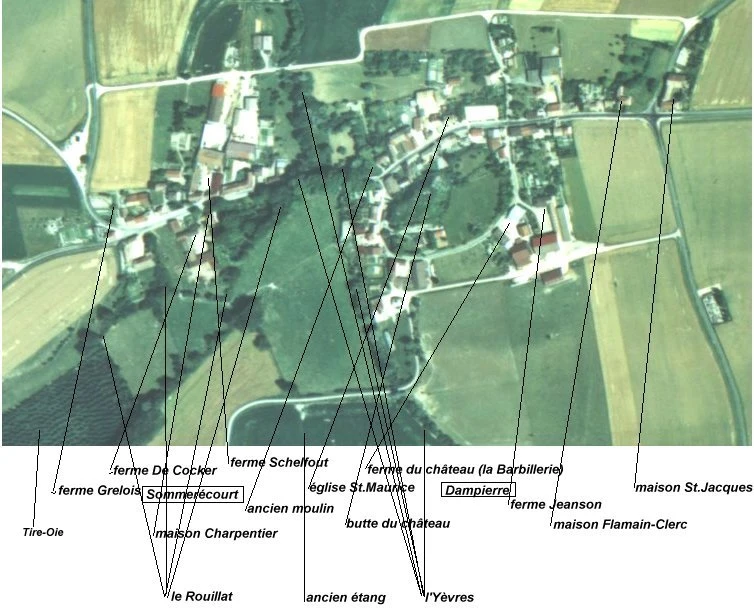
1915 and 1916 in Epernay
Another great attack in Champagne, everyone is haunting, especially the Rémois who see deliverance. We approach the walk without almost knowing each other, but the hope is very disappointed... nothing and on October 1 we will see René again in Paris, and the next day he leaves for the front! Poor little, he is 18 1/2 and not very robust. He sends us a box containing his things in which I see a coffin and we both weep my husband and me!... Angoisses, sadties, what winter is getting ready and Georges who suffers so often. We're being minimized anyway.
Marcel is in class in Epernay and Etienne entered Henri IV. Suzanne was received at his patent on the day we learned René's departure, so his success went unnoticed.
Visiting our owner, increasingly unpleasant. She regrets having rented us her house so cheap (150f a month and furnished) but she is so arrogant that we do not want to give her more. There is accommodation, we were able to receive my parents then the Thirion, the Andres and their baby, finally it will not always last, hopefully.
On 1 January 16 Georges was appointed Chief Engineer, the rank, which we no longer hoped then he did not want to leave Reims and his service, arrives today by a promotion of war. It is true that he is in the zone of armies and when he goes to Reims, it bombards. The roads are camouflaged with canvases that prevent passing cars, and sentries are frequent.
The battle of Verdun in February, the emigrants arrive again in crowd. We talk about evacuating the hospitals of Châlons. My parents who were to come this week arrive without changing anything, first and then Dad after a very difficult journey. He is caught from an attack of paralysis when he returns, stops at Châlons, and returns to Dampierre in a very precarious state.
We receive a letter from René who came without one day late (and by the front there are always 4 days of arrest). He is quietly in Berzieux (not far from Dampierre) and does not speak of being sent to Verdun.
A few days before Easter, we think of going to Dampierre by car, passing through Argers (ten km from Dampierre!) where René is confined. We can take him with us, and we have lunch in Dampierre with a colonel who has been staying there for a long time. Mom is at best with all these officers, generals and colonels and thanks to one of them René has an additional permission. He is brigadier and has taken back a good look. What a difference with the months at Chartres' depot!
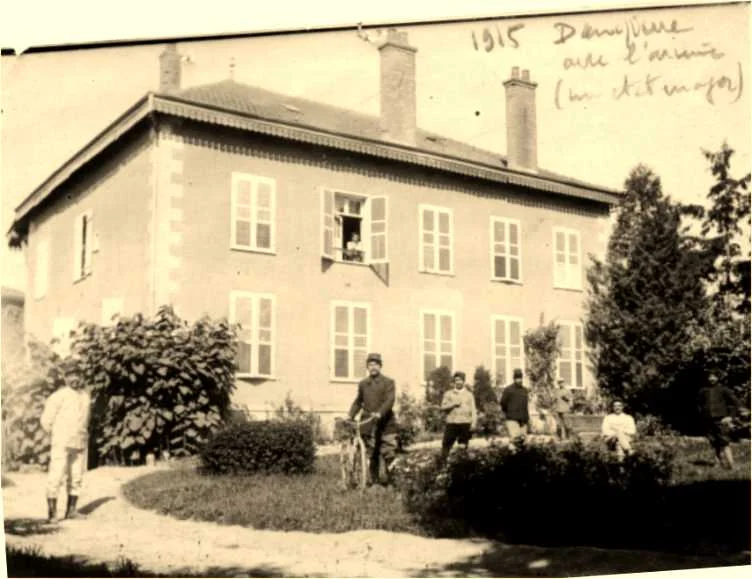
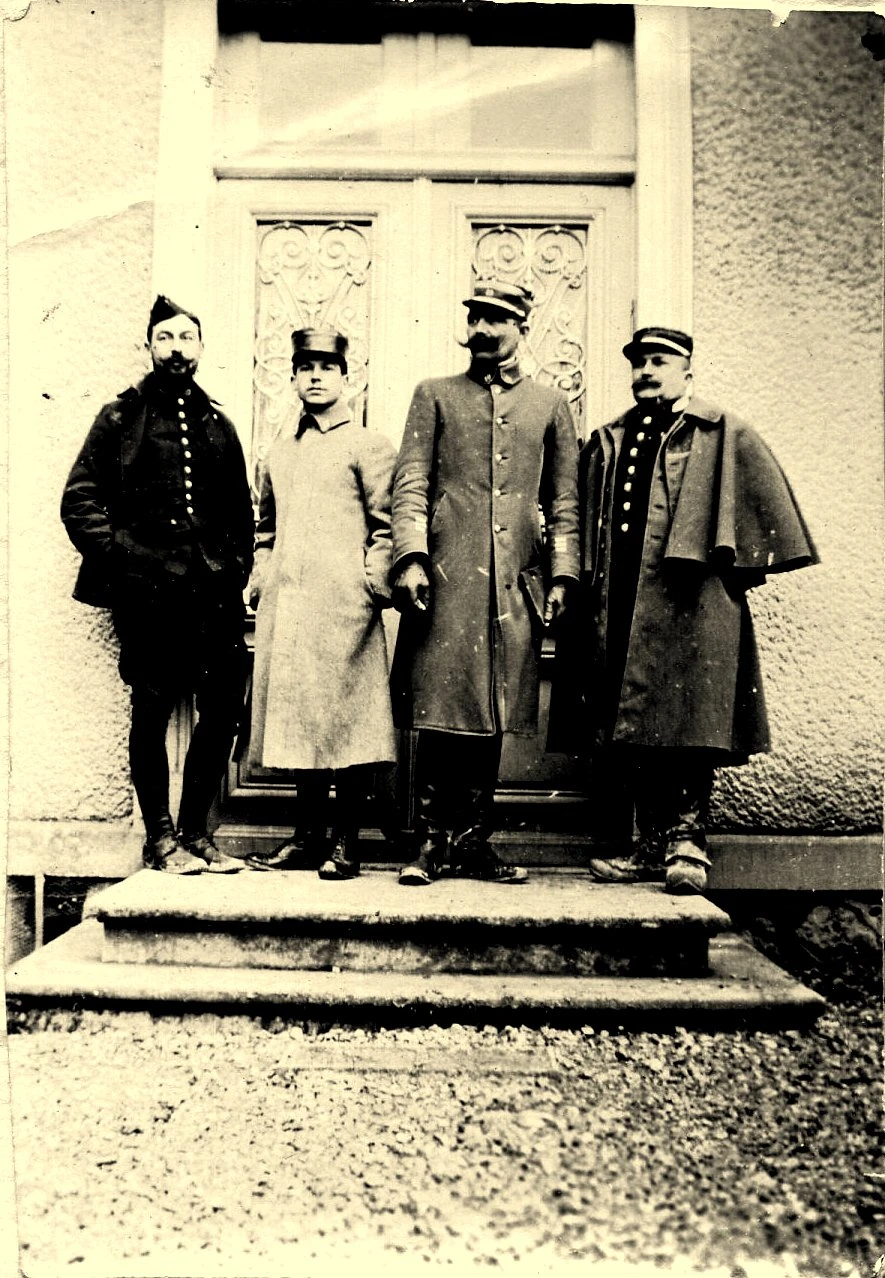
1915 the Charpentier's house in Dampierre was occupied by a French staff, after a brief occupation by the Germans at the time of the 1st Battle of the Marne
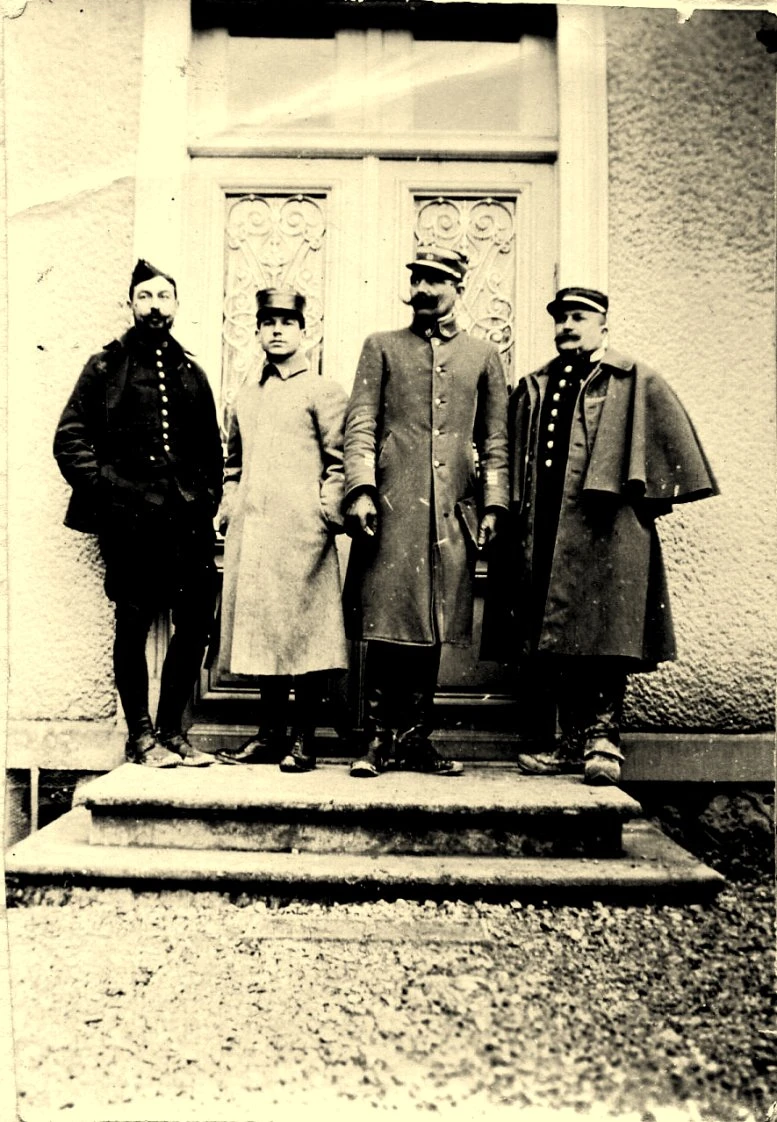
(details) Officers staying in the Charpentier property in Dampierre in February 1915
The bombings of Reims continue, and we are being hired to move. We bring back a large part of our furniture and I can go to rue Boulard to move my mother-in-law. Our house, which has been occupied for months by soldiers, even by a popot, has nothing of the intimacy of the past and I see it without emotion. A yellow rose that is all in bloom despite the bombs reminds me of my little garden!... We eat in a café near St-Jacques, poor church that I visit and is well lamentable.
The few people who stayed in the city's shops look with curiosity at the returnees like us. The damage is considerable. The Royal Square, whose facades alone remain and the entire St-Symphorian neighbourhood, which is a great field of ruins...
In September (1916) we move our house completely. Georges leaves the service, he can't and he chose the Touraine to withdraw. I go there without enthusiasm, but as it had been mentioned Brive-la-Gaillarde I am still satisfied. It is exile again (exile in St-Cyr sur Loire, suburbs of Tours, they will stay there until their move to Sceaux in 1920) Difficult settlement with our friendly owner, who accuses us of having stolen it! Finally we leave and say goodbye to the slopes of the Marne to go to the Loire.
_________________________________________________________
2 SUPPLEMENTS transcribed from Marguerite Maillet's handwritten notebooks
Epernay, December 1915
Where are the good days, the happy days
And the road in bloom for a while
When is the blue sky?
And France in peace, returning to life?
My husband, my son in danger,
The exile is cruel to the poor mother,
When will we find our dear home
So beautiful, compared to the austere life?
The cannon often guides the thought
To these terrible places where the fighting is,
And my dear child so young
To the harsh life a soldier has to live.
Protect France, O God of my soul
No one can but you, to deliver it
Suck heads that the ardour is burning
And whose value will save us
____________________________________
(Scales) Christmas 1928 (extract)
My George left me three weeks ago - the happiness of my life, the 33-year-old companion I loved so much!. Our wedding beginnings so happy, without business concerns - he had such a pleasant profession - nor health. Unfortunately we have paid well since! Yet I keep above all the memories of the years of happiness where I was all for him to be pleasant and he, far superior to me, formed me and raised me so delicately and without almost realizing it....
.........Our dear Werlé Street, that it contains, also the day our lease extended by the war ended definitively we wept together and leaving it on September 1 (1914) what a tear my God.
All this is the past and my dear husband after suffering well, entered the rest....
______________________________________________