


6530
History of the piano called "Nany"
Pleyel, 1/2 tail, length about 2m20
No. 31986, year of construction 1861 (probably beginning)
(See Pleyel piano dating summary guide)
___________________________
By whom was it purchased? and how did it arrive in Vierville?
2 possibilities:
1/ First chance, purchased by Charles Weill junior, Nany's grandma
Charles Weill junior (1815-1893) was born in Alsace in Bischeim (Strasbourg), son of a Jewish horse merchant, also named Charles Weill (senior), born in 1768 in Marmoutier and died in Malakoff around 1873, more than a century.
Charles Weill (junior) 1815-1893, was a linker, but also a professor, and a Catholic who was converted by his marriage to the Parisian Augustine Hénos (1812 - 1877), a linker.
Charles spent time in Vienna (Austria) as the tutor of an Austrian prince (archduke at the court of the Emperor of Austria-Hungary). One of his children Isidore-Frédéric was born in Vienna in 1844, the others were born in Paris.
It is known that in 1872 Charles Weill (junior) lived in Malakoff, in the southern suburbs of Paris, at 35 rue de la Tour (in the house his father had built and where he was finishing his life).
Charles Weill and Augustine Hénos had 5 children:
* Charles-Albert Weill, 1841 - 1853, died accidentally at the age of 12.
* Isidore-Frédéric Weill, 1844 - 1918, born in Vienna, a broker, father of 9 children (two marriages), including canon Frédéric Weill.
* Auguste Alphonse Weill, born in Paris in 1846, grocer in Paris, married to Angèle Carré.
* Eugénie Weill, 1848 - 1900, mother of Nany
* Adeline Weill, 1852 - 1944, known as Tantine, married to Amédée Collard 1834 - 1909, Colonial Infantry Officer
The 2 daughters Eugénie and Adeline Weill were born (in Paris in the 11th Arrdt), in 1848 and 1852.
The Pleyel that remained with us was made in 1861 and would have been destined for the girls.
His destiny would then have been that Eugenia (wife Georges) inherited it on the death of his parents (1877 and 1893) and had it carried to Cherbourg at the latest around 1893.
In 1900, when Eugénie died, the piano would have passed to the first of her 2 daughters: Jeanne Bastien (called Mara) who lived in Cherbourg with her husband Robert Gervais (known as Tonton Robert). Mara died in 1928. The other possible heiress, Mara's second daughter and half-sister: Marguerite Georges (Nany, wife Hausermann), was living abroad and could not take over the piano.
[Nany and her husband Daddy were in Bizerte since 1897, then in Rosario from 1906 to 1912. Upon their return from Argentina in 1912, Daddy and Nany rented a large apartment at 123 rue de Longchamp.]
The piano would then have passed from Mara (without children) to Nany between 1912 and the 1920s, without any knowledge of the circumstances and date.
In any case, the piano was at the Château de Vierville in the 1920s (witness of Philippe - born in 1918 - who remembered it well and always saw it at the castle. He said there was another piano at Nany's in his salon rue de Longchamp, it was a right piano, which then went in 1933 Avenue de Lamballe during the move of Nany).
The piano was first photographed at the Château de Vierville in 1933 (see below).
2/ Second possibility, the piano was bought by the Hausermanns on their return from Argentina in 1912. It's less likely because Daddy wasn't a man to buy a second-hand piano (this piano was about 50 years old).
[In this hypothesis, it must be thought that the Charles Weill Jr had to buy another piano from which Tantine would have inherited. Indeed, she had a piano in Paris in the 1930s, with which she often played and sometimes with four hands with her niece Nany 20 years younger. This piano certainly remained with her children and cannot be Viervillle's.]
The piano was in Vierville in 1940 when the Germans arrived on June 18 or 19, 40. Several rooms of the castle were then occupied by German officers.
Nany received a German colonel in the "music hall" (1st room on the left, climbing through the large staircase, the current "office" of the castle). The Colonel's maps were deployed on the piano, Nany explained to the Colonel that she could not accommodate him, having all his family to welcome him and showed him on maps the other castles of the area where he could be housed (witness of Martha, Nany's maid, who attended the stage). The piano was installed against the wall, opposite the fireplace, the keyboard near the palier door.
[The Germans finally installed their Kommandatur at the Than mansion in the automne 1940, which had become empty, left by the Poivre family returning to Paris after a year of retreat in the mansion. The castle was then occupied only by 1 or 2 German officers until 4 March 1944]
After Nany's death in Vierville in February 1941, the piano remained in the small chateau's living room (see photo below). The castle was then the permanent dwelling of Nany's old domestic, Martha, and the place of stay on holiday of the Cordelle and Chedal until the division of Nany's estate in 1946.
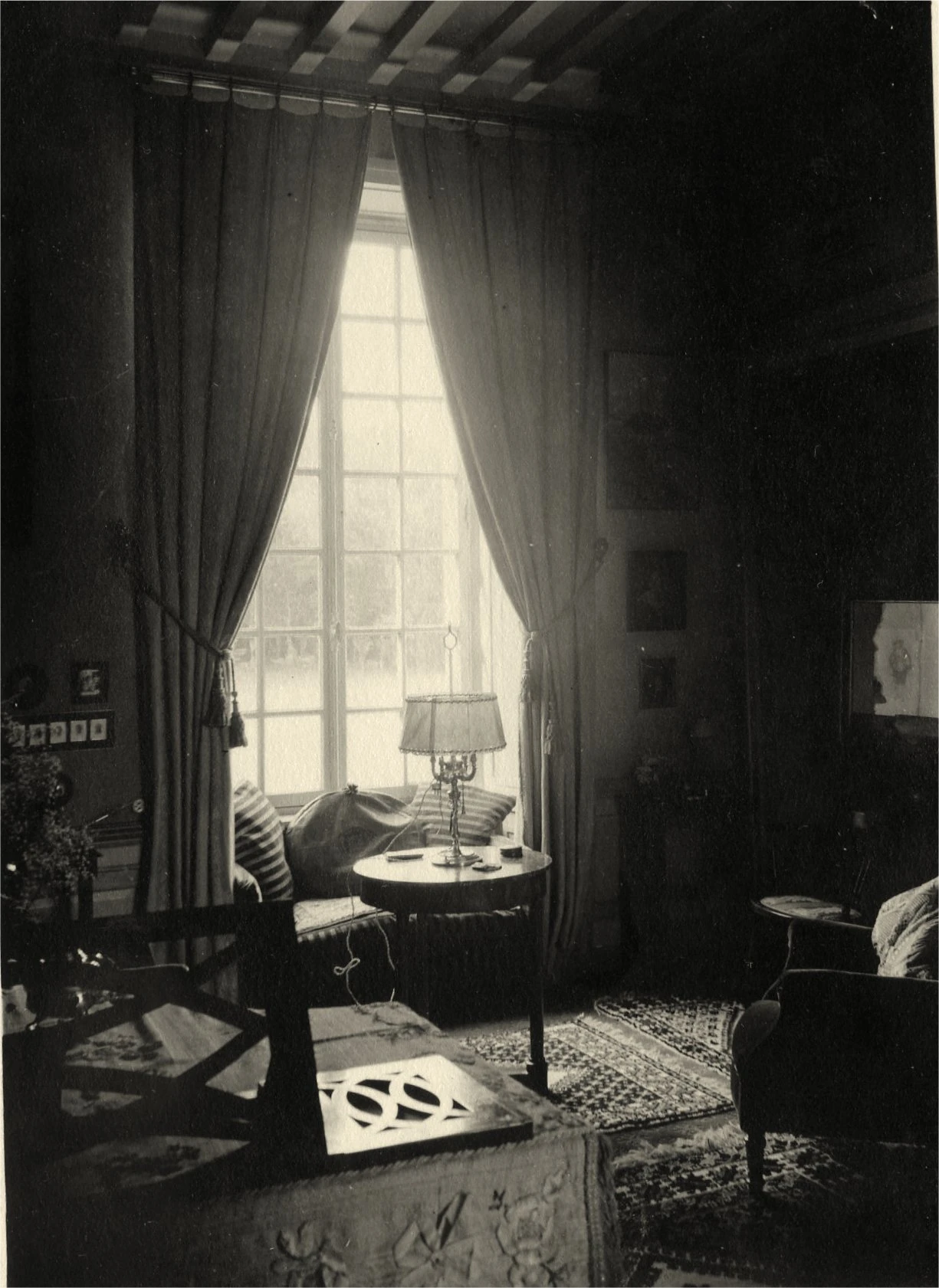
At the Château de Vierville, the small living room on the 1st floor in 1933 with the piano in the foreground.
How did the piano leave Vierville?
On 29 February 1944, the Germans, who had so far only requisitioned one or two rooms for officers, gave the family a full 3 days to move. It was done within this time. George and Suzanne Chedal and Simone Cordelle were able to arrive from Paris at the end of the 1st day, the move to the presbytery (empty since the death of Abbé Robert in winter 1940) being already well engaged by mayor Fernand Leterrier, Michel Hardelay and the other inhabitants (all, an anthill of Viervillis, with many carts and other banals tied to horses).
[In 1944, the mayor was Fernand Leterrier, set up in January 1941 (or 1942?) by the Prefect of Calvados, to replace the elected mayor Hippolyte Dubois that the Germans no longer supported for various reasons, one of which was that Father Dubois spoke fluently German.]
Jean Cordelle was able to find a moving truck that came from Paris and took the most valuable furniture, including the piano, which were placed in the apartment of Nany avenue de Lamballe on the 4th right (furnished but unoccupied apartment since the summer of 1939).
After the division of the estate (1946), each awardee took away his furniture. The piano was awarded to the Cordelle, and he was moved to Saint-Laurent, Prieuré (purchased in 1947 by the Cordelle).
In the Priory, the piano was installed in the living room on the ground floor. He was probably reunited by a professional in the late 1940s, but he rarely served effectively. This is what Denis Cordelle said (born 1953 and thus able to play there in the 70s and 80s):
"Yes of course I remember the piano of the Priory very well. I played it many times myself. And as it was very disagreeable, I even gave it several times. I had so moved it from pan to "playable". Obviously far from a professional agreement, but acceptable enough to draw some pleasant sounds. It must be said that it suffered a lot of moisture during the winter. To my knowledge, no one else touched it, but I was not there all the time. (born 1945) I think he was more flute and cello than piano, and I don't think there were any other pianists in the family.
{After the death of Jean and Simone Cordelle (1984 and 1987), the piano was troubled to François who moved it to the part of the Priory which he had inherited, then around the 1990s in his property of Forges (near Saumur).In 2011 he gave it to Jean-Paul Hausermann who installed it again at the castle of Vierville, in the large library salon on the 1st floor}