


Travel from the Hausermann to Chile,
in 1909
4955
We still have many verascopes of this journey, preserved by Jean-Paul: the train, the cars, the mules, the great statue of Christ on the pass, the 3 children on a black sand beach (the basalt, Simone's memory).
To see these verascopes, click on
Crossing the Andes 1
Crossing the Andes 2
Crossing the Andes 3
Beaches in Chile
The port of Valparaiso
You can also consult a Daddy's account book in Chile in 1908
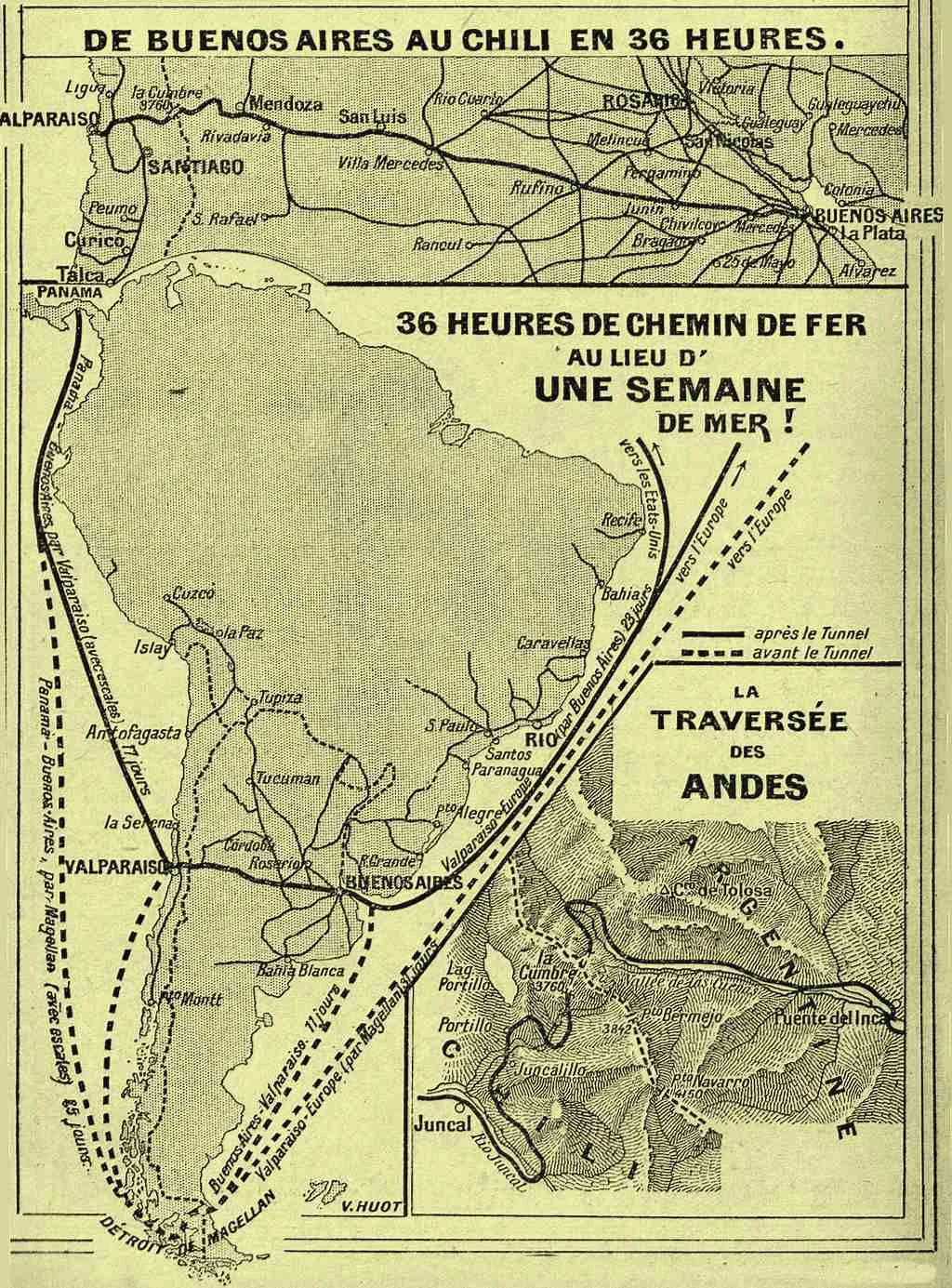
In 1908, the trip from Buenos Aires to Santiago de Chile could not be made entirely by rail. It was necessary to either take a boat and go around Cape Horn or take the railway, but it had to leave to pass the Andes pass with mule, a solution that was used by Daddy accompanied by Nanny and the 3 children Suzanne, Simone and Jean Hausermann.
The Ferroviare tunnel under the Andes was put into operation in 1910:
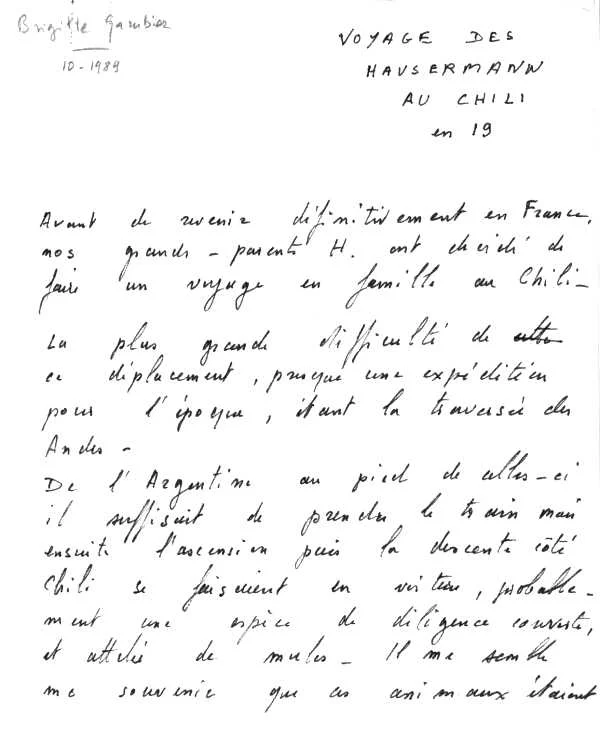
"Before returning to France for good, our grandparents Hausermann decided to take a family trip to Chile. The biggest difficulty of this trip, almost an expedition for the time, was the crossing of the Andes.
From Argentina to the foot of the train, it was enough to take the train, but then the ascent and the descent side of Chile were made by car, probably a kind of covered stage, and coupled with mules. I think I remember that there were six of these animals. This part of the journey, probably very moving and picturesque, seems to have hit Mom (Suzanne Chedal Anglay) and Aunt Simone (Simone Cordelle) at the time. Totony (Jean Hausermann) never told me about it, but he was obviously still very young.
As usual when you hear two versions of the same fact, it seems quite different according to the personality of the person who expresses itself and the characters and interests of the two sisters make appear very different facets of this event of their young lives. I will therefore try to remember the details that have struck me most and amused me by both their picturesque and their complementary.
Only the passengers were entitled to the car, the luggage, many at the time, was carried on a mule. The loads were secured on each side of the animal by trying to balance the weights. Thus, our grandmother's hat box had been surmounted with a large stone not adapted to its thickness. Of respectable size (a cube of about 70 cm), it was very light containing only hats (two or three stacked on each of the six sides) of scarves and gloves in the middle.(This hat trunk was kept at Yves's in Vierville).
The mules were loaded, they were given a big whip, and they were carried out with great blows of kidneys without help or supervision. Woe to the one who had no confidence, or to the luggage that was untied. Thus, Nany was watching with great concern his hat trunk at every detour of the road fearing to find his hats crushed by the famous rock.
The lid had to resist since every summer, even after the landing, one took advantage of a rainy day in Vierville to open the large chest under the staircase and check the condition of some hats returned from this long journey. Naphthalin was added not to forget to try them to the great joy of the assistants. Sizes more than respectable, even those of the girls (a beige boy-sighted way for the trip, white tulle and flower, for the Sundays). Nany had one on which tucked a gull with the wings deployed. That is its wings! ...
In the patache (bad quality car), another hat story,- Mom was sitting in front of a merchant traveller, widowed and accompanied by her two children. This one, not having the right trunk and unable to separate from the hats he owned because they were, at the time, indispensable for his employment, had simply piled them on his skull, high in shape, felt, canoeing to crown the whole. It must indeed have had a cunning appearance...
Aunt Simone, more attracted by nature to the animal gen, had noticed that the mule tree was a manchot. He therefore led his animals, the reins between his teeth, the valid arm handling the whip with energy to animate his animals both on the climb and on the descent which had left him with an impressive memory. It is quite well understood that the speed combined with the lacing of the road opening on the at-pics should give him vertigo.
Arrival in Lima (or rather Santiago?)It was the typhoid, a very serious and contagious disease (one of the only ones she had ever suffered with severe pleurisy around the 30s). On the advice of the French ambassador who was not confident in the services of the local hospital, Daddy had to rent a whole floor of the hotel to treat her daughter for 40 days.
The customs of Chile were very special and even backward, compared to those of Argentina. Thus Nany had to borrow one of her long coats from the ambassador to go to Mass on Sunday. Shame to the poor woman who appeared in service with a hat, it had been displayed as a "lost daughter"!
I doubt that Mother's illness really allowed our grandparents to visit Chile according to their intention, besides no other memory, neither of the stay nor of the return was told, what a misfortune I was not more curious...